4 hr
Southern Flavours Food Tour with 15+ Tastings
Explore Phuket Old Town's culinary heritage through morning market stops and hidden eateries
Reserve
Hand-picked by our editors — only the best 5 experiences from 23 reviewed.
Verified partners for every tour, free cancellation where available, and instant confirmation on every booking.
4 hr
Explore Phuket Old Town's culinary heritage through morning market stops and hidden eateries
Reserve
4 hr
Intimate culinary journey through UNESCO-recognized Old Town with over 15 authentic street tastings
Reserve
24 hr
Explore Phuket's cultural highlights, scenic viewpoints, and historic old town with guided transport
ReservePrices from verified partners. Availability updates in real time at checkout. Free cancellation policies apply where shown.
The landmarks, rooms, and views travelers on this tour remember — all visible on a single visit.
This main thoroughfare is famous for its vibrant Sino-Portuguese architecture and Sunday markets. It served as the original commercial heart of the tin-mining era.
Once a historic red-light district, this narrow alley is now home to quaint cafes and colorful heritage houses. It is one of the most photographed spots in the area.
Housed in a grand 1934 mansion, this museum details the Chinese immigration history of the island. It is an essential stop to understand local culture.
A prominent Taoist temple known for its vegetarian festival and striking red architecture. It remains a spiritual anchor for the local community.
A preserved 1903 mansion showcasing authentic antique furniture and the life of a wealthy tin-mining family. It is a rare glimpse into the past.
They complement each other; most visitors who do both call the guided Phuket food walking tour the more informative, while the independent walk offers superior flexibility. Booking phuket food walking tour tickets provides deep historical context, whereas the alternative is ideal for those who prefer to explore Sino-Portuguese heritage sites at their own pace.
| Feature | Top pick Phuket Food Walking Tour | Self-Guided Food Walk |
|---|---|---|
Structure |
Pre-planned itinerary | Unstructured exploration |
Local Expertise |
Professional local guide | None |
Food Variety |
Curated tastings | Self-selected vendor stalls |
Convenience |
All logistics handled | Requires own planning |
Cost |
Varies by provider | 0 THB entry fees |
Navigation |
Follow-the-leader | Requires digital map |
| See tickets → |
Verdict: The Phuket food walking tour provides a deeper dive into culinary traditions, while those seeking a budget-friendly phuket food walking tour tour may prefer the spontaneous nature of self-guided phuket food walking tour tours.
Choose your ticket, select your date, and reserve in under two minutes. Secure checkout handled by our verified partner.
Instant confirmation by email, with a mobile voucher you can save offline. No printing, no queuing at a collection desk.
Arrive at the entrance, show your voucher on your phone, and walk in. Most tickets include priority or skip-the-line access.
Practical details for your visit straight from our verified partners — hours, access, rules, and how to get there.
Modest clothing is recommended when visiting shrines or temples within the district. Avoid swimwear on public streets during your phuket food walking tour.
Keep valuables secure in a crossbody bag while navigating crowded streets. There are no centralized security checkpoints for this open-air attraction.
Phuket Old Town is highly photogenic; respect private property and local residents when capturing images. Always ask before photographing people on your phuket food walking tour.
While the area is flat and walkable, many historic shophouses have narrow doorways or steps. A phuket food walking tour may involve uneven sidewalks in older sections.
The area is family-friendly, though be mindful of traffic on main roads. A phuket food walking tour is a great way for children to sample local snacks.
The district is a hub for Peranakan cuisine; sample local favorites like Hokkien noodles and moo hong. Stay hydrated during your phuket food walking tour.
Best time to go, insider tips, nearby landmarks, and the cancellation fine print — flip through to skim what matters to you.
Flexible, no hidden fees.
As this is a public area, no tickets are required for entry to the streets. For any guided phuket food walking tour, please check individual operator terms for refund windows.
Phuket Old Town's culinary identity was built on tin-mining wealth and Peranakan fusion, not tourism. In the late nineteenth century, Hokkien traders and Malay cooks married their pantries along Thalang Road, creating Baba cuisine—a dialect of tamarind, palm sugar, and turmeric that belongs to no single region. The shophouses that line Dibuk and Yaowarat Roads were commissioned by rubber barons who wanted European facades and Chinese courtyards, and their ground floors became teahouses, dim sum kitchens, and roti stalls that fed dockworkers before dawn. Today, those same kitchens serve moo hong, oh aew, and kanom jeen in dining rooms whose ceiling fans predate air conditioning. A Phuket food walking tour through these streets is not a restaurant crawl—it is a lesson in adaptive foodways. The Hokkien mee sold at corner hawker stalls uses tamarind juice instead of soy, a substitution born from supply-chain isolation. The coconut cakes sold at Ranong Road's morning market are dyed with pandan and butterfly pea, colors that signal freshness in a climate where refrigeration arrived late. Every vendor operates on memory and ratio, not recipes, and the rhythm of their workday—steaming buns at five, frying spring rolls at eleven, grilling satay at six—has governed Phuket Old Town food culture longer than the island has had paved roads. The architectural context matters because the food evolved inside it. Sino-Portuguese shophouses were designed with open courtyards to ventilate charcoal smoke, and those courtyards became the shared kitchens where neighbors taught each other to ferment shrimp paste and roll lumpia wrappers. The tile mosaics underfoot—Italian imports stamped with geometric florals—were laid by the same families who now run third-generation noodle shops. A culinary walking tour of Phuket Old Town is also a tour of adaptive architecture, where every threshold and transom window tells a story about heat, commerce, and the social life of cooking. Most evening food tours depart between four and eight, when temperatures drop and vendors light their grills. The routes concentrate along Thalang, Phang Nga, and Dibuk Roads, where fifteen to twenty tastings might include khanom krok, satay, roti pancakes, and oh aew—a shaved-ice dessert flavored with grass jelly and served in a porcelain bowl. Guides are typically Phuket-born, and their commentary runs toward family genealogy and ingredient sourcing rather than culinary theory. The walk itself covers two to three kilometers, enough to justify the caloric intake and see the district's restored facades under lantern light.

"Every vendor operates on memory and ratio, not recipes, and the rhythm of their workday has governed Phuket Old Town food culture longer than the island has had paved roads."
A step-by-step walkthrough of the visit — what you'll see, how long each stage takes, and the details that matter.
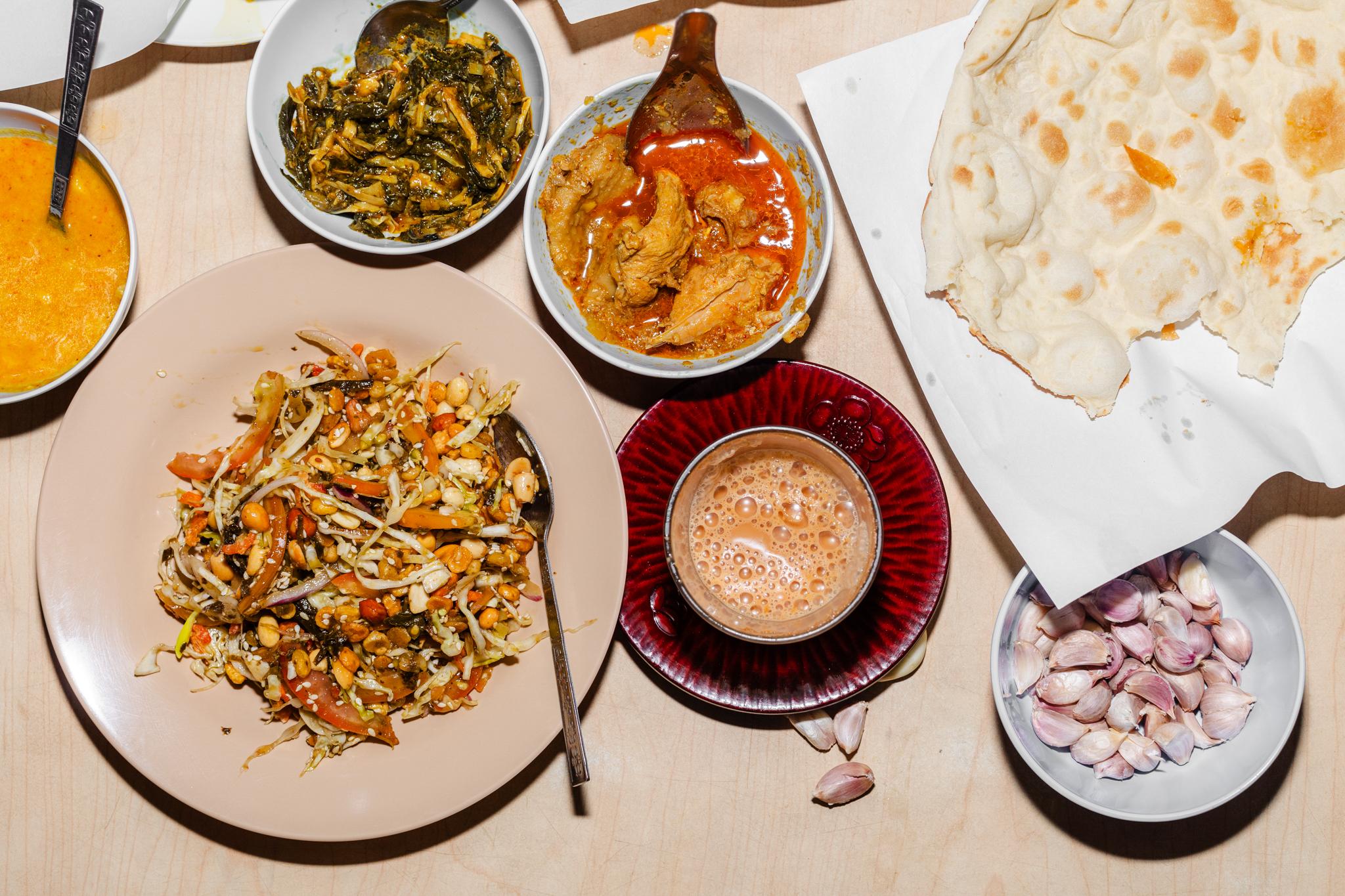
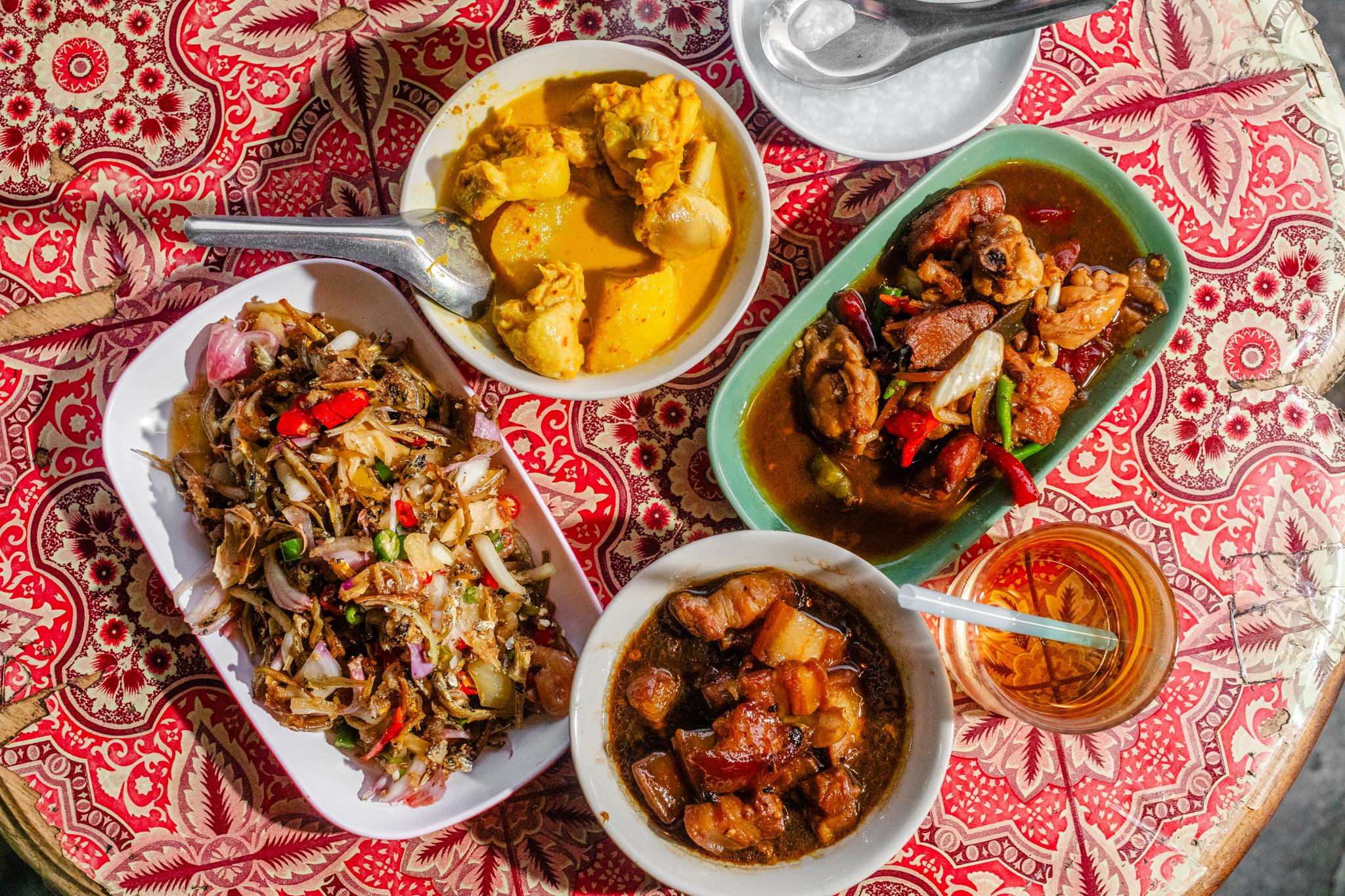
You meet your guide near the corner of Thalang and Phang Nga Roads as the afternoon heat breaks. The first stop is a Hokkien mee cart where the vendor ladles tamarind-dark broth over rice noodles and pork belly, the bowl finished with a wedge of lime and fried garlic. You eat standing, the way dockworkers did a century ago, then walk two blocks to a Baba kitchen tucked inside a restored shophouse. The chef serves moo hong—braised pork in five-spice and palm sugar—on a tin plate, and you taste the caramelization before the spice. The route continues through Dibuk Road, where you stop for roti pancakes at a cart that has occupied the same corner since 1978. The vendor stretches the dough by hand, slaps it onto a flat griddle, and folds it over banana and condensed milk. Three blocks later, you reach a kanom jeen stall where curry is ladled from clay pots and served over fermented rice noodles, the plate piled with fresh vegetables and herbs you pick yourself. The final tasting is oh aew, a shaved-ice dessert flavored with grass jelly, served in a porcelain bowl at a stall near Ranong Road. You finish as the shophouse lanterns come on and the evening market begins to assemble its grills.
The district is open 00:00–23:59, so you can explore anytime, though tours often run during the 16:00–20:00 arrival window.
While the streets are flat, some heritage sites are not wheelchair accessible, so check with your specific tour operator.
We recommend the 16:00–20:00 window for cooler temperatures and active markets.
Yes, children are welcome on a phuket food walking tour, making it a great cultural experience for families.
Bring comfortable walking shoes, sunscreen, and a camera to document your phuket food walking tour.
Entry to the streets is 0 THB, but guided phuket food walking tour tickets should be purchased in advance.
Yes, photography is encouraged on your phuket food walking tour; just respect private property.
Dress modestly when visiting shrines on your phuket food walking tour; keep beachwear for the coast.
Most operators provide pick-up services or meet at central landmarks within Phuket Old Town.